By Stella | 29 May 2026 | 0 Comments
The Power of Spatial Layering: Why Vertical Lighting Matters in Office Design | ZJESL
The Power of Spatial Layering: Why Vertical Lighting Matters in Office Design
When reviewing an office lighting layout, it is incredibly easy to fall into the "downward trap." Most project calculations focus entirely on horizontal illuminance—measuring how many lux fall onto desk surfaces from above.
However, humans don't navigate the world looking straight down. We perceive our environment through horizontal and vertical fields of view. To create a workspace that feels truly spacious, comfortable, and premium, professional lighting designers prioritize vertical luminance (lighting walls and vertical surfaces).
Here is why vertical lighting layers are a game-changer for commercial spaces, regardless of whether you choose suspended linear configurations, wall-integrated setups, or recessed luminaires.
1. Eliminating the "Tunnel Vision" Cognitive Fatigue
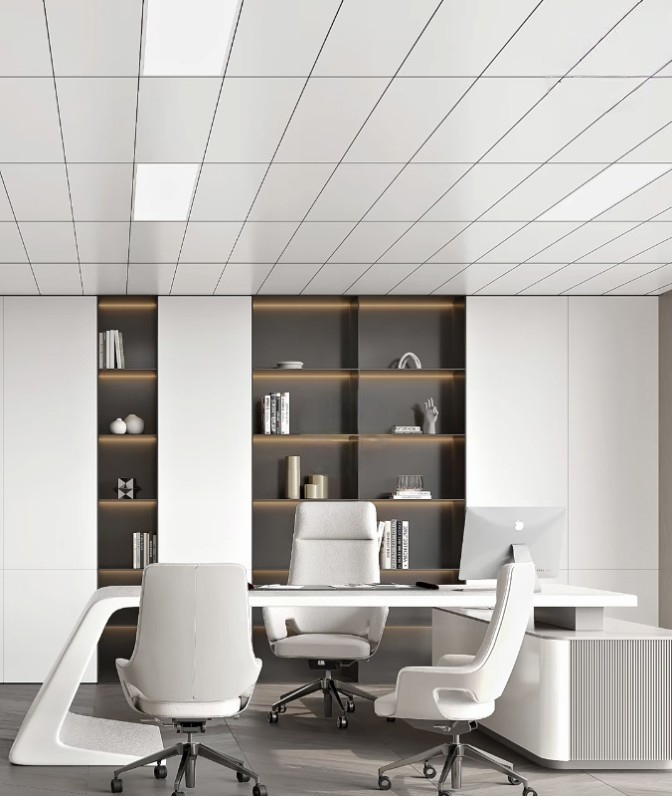
If an office only has downward-facing troffers or panels, the walls remain dark. This creates a high contrast between a bright desk and a gloomy perimeter, forcing the human eye to constantly adjust as it glances around the room.
The Fix: Incorporating soft wall washing or indirect perimeter lighting balances the brightness ratios within the room.
By elevating the average cylindrical illuminance, you reduce the eye strain associated with heavy contrast, allowing the eyes to rest naturally when workers look away from their monitors.
2. Visually Expanding Compact Footprints
Light colors and bright surfaces expand spaces. In dense corporate environments or narrow architectural corridors, uniform downward light can feel oppressive.
The Optical Illusion: Lighting a vertical surface shifts the psychological boundary of the room. When a wall is evenly illuminated, the human brain perceives that wall as being farther away.
This technique immediately makes tight conference rooms, reception areas, and structural corridors feel wider, higher, and significantly more premium.
3. Creating "Visual Anchors" for Focus and Direction
A high-end office should have a logical visual hierarchy. When everything is flooded with identical, flat ambient light, nothing stands out, and the space lacks character.
Strategic Contrast: Using controlled beam angles to highlight vertical textures—like wood paneling, artwork, or architectural features—creates natural focal points.
This subtle contrast breaks up the monotony of long rows of open desks, injects energy into breakout zones, and gives the overall floor plan a sophisticated, multi-layered depth.
Seamless Integration Across All Planes
Achieving professional vertical and horizontal lighting balance shouldn't mean managing multiple disparate fixture styles.
At ZJESL, we design comprehensive optical platforms engineered to deliver high color fidelity (Ra > 90) and excellent glare control, engineered within unified physical form factors. Whether your architectural layout calls for a suspended run across an open-plan bullpen, a sleek wall installation in a corridor, or a surface-mounted module in a low-ceiling suite, our systems maintain identical color binning and aesthetic finishes across the entire project.
Leave a Reply
Your email address will not be published.Required fields are marked. *